
What is the difference between a medieval Staddle Stone and todays Urban Plinths?
Well, apart from a few hundred years, not a lot really! Both systems do almost exactly the same job of providing a foundation support to a building that raises it off the ground.
Staddle stones could also be found in Spain and Norway as well as England supporting all types of buildings from Granaries to large barns. The base stones taper towards the top with an overlapping cap stone placed above. The air could freely circulate beneath the stored crops and this helped to keep the interiors dry. A wood framework was placed onto the tops of the stones, the staddles being arranged in two or three rows, giving sixteen or more stones. The barns, storage buildings or hayricks etc. were built on top of this frame.
Urban Plinths perform exactly the same role—the only difference is that todays plinth foundations are designed by a chartered structural engineer and the bracket tops vary in design to carry different size timbers and varying beam types.
The word “staddle” is derived from the Old English “stathol” meaning a base or support. Stone staddles are known to have been used as early as medieval times (the 5th to the late 15th century). Structures called “helms” that were supported by staddle stones and used for the storage of crops are mentioned on a number of occasions in 15th-century court rolls in England.
It’s ironic that this form of building foundation served timber buildings for centuries until the arrival of the dreaded concrete. Although concrete of a sort had been used in Roman times (opus caementicium) it fell out of favour for centuries until it was re-invented by Smeaton in the late 1700’s but didn’t come into general use until around 1870 when a French chap called Joseph Monier received a patent in 1867 for his invention “ferro concrete” or reinforced concrete.
Since this time the world has been awash with concrete foundations installed for all types of buildings. Recent awareness of climate change and the need to vastly reduce carbon emissions by abandoning the use of quarry products in construction, has directed us back to old systems although grandly referred to as Modern Methods of Construction (MMC). The Urban Plinth is just a modern engineered version of the very old ecological Staddle Stone system that contributes to reducing embodied energy generated by construction materials from cradle to gate.
STADDLE STONE URBAN PLINTH
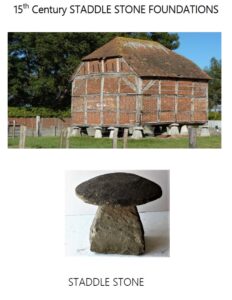
15th Century Staddle Stone
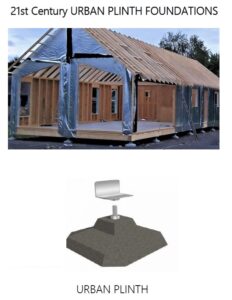
21st Century Urban Plinth